DESIGN SYSTEMS ✻ EDUCATION

Role
Lead product designer
Collaborators
3 accessibility consultants, 3 product team champions
timeline
Oct 2024 - Jan 2025
Accessibility is a key Splunk UI value, yet there is a gap between the system compliance and execution in product. While our components were accessible, page level designs and unclear handoff led to inconsistent implementation, and a very expensive backlog of 1000+ accessibility bug tickets. Not only is fixing these issues time intensive, but it also poses legal risk. The Accessibility Annotation Kit was the solution to prevent accessibility issues from the earliest design stages and reduce handoff time.
THE CHALLENGE
Despite organizational buy-in, accessibility documentation remained a significant bottleneck. To move past the 'grassroots' failures of the past, I conducted a forensic audit of the existing v0 library and interviewed A11y Champions across product teams. I identified three systemic barriers to adoption:
Technical debt in design tooling
The previous kit was built as a side project without rigorous QA. Component-level bugs and a "bulky" architecture created more friction than they solved. Designers weren't opting out of accessibility—they were opting out of a tool that hindered their creative flow.
Knowledge vs. execution gap
While there was a high intent to design inclusively, there was a systemic gap in 'how' to document intent for engineering. This resulted in an over-reliance on the design system for compliance, neglecting the critical role of designer-led assistive technology specs.
Operational friction at scale
The previous kit failed to account for designer velocity. Because the documentation process was seen as an additive, 'tedious' task rather than an integrated step, it was frequently sacrificed during tight release windows, directly contributing to our 1,000+ bug backlog."
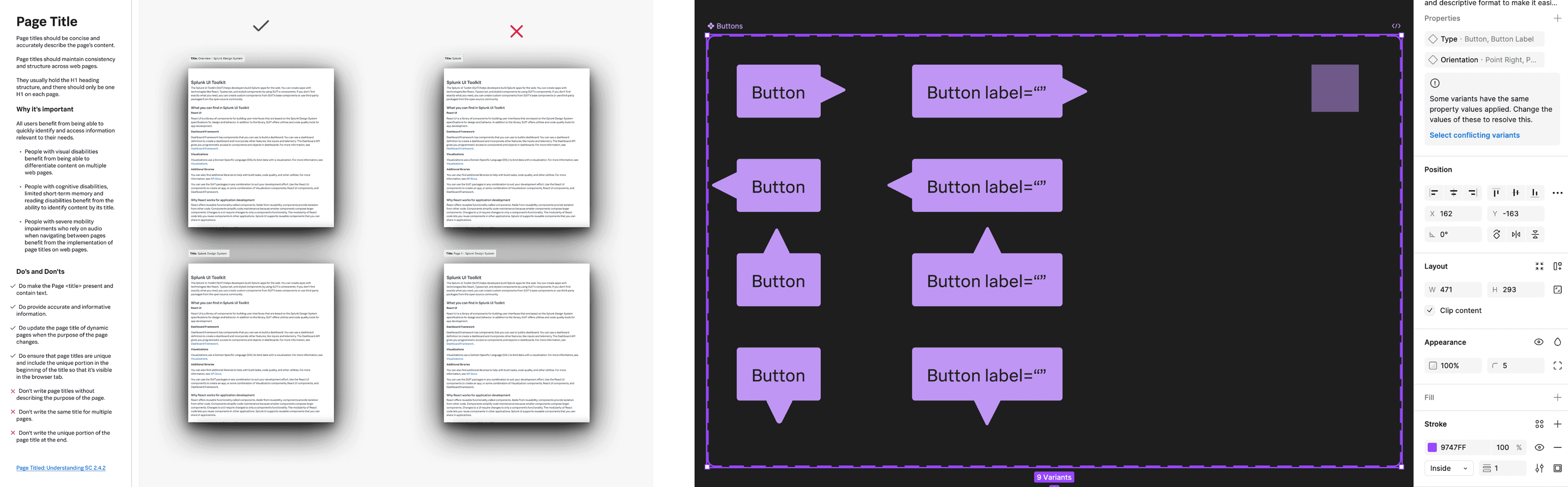
The previous annotation kit had mistakes in component build and difficult to read examples, making it hard for designers to use it effectively in their work.
After auditing the failures of v0, I faced a crossroads: Was a library of flags actually the right solution? I recognized that even the best annotation kit carries two inherent risks: it requires baseline accessibility expertise and adds manual effort to an already tight design cycle.
However, after consulting with our Accessibility Leads and core design teams, I arrived at a key insight: The friction of manual annotation is a feature, not a bug. I decided that the act of labeling work is a pedagogical tool—it forces designers to mentally 'walk through' the page as an assistive technology user would. My strategy for v1.0 shifted from 'just providing assets' to augmenting the workflow to make this 'intentional friction' as approachable as possible.
My v1.0 approach focused on three pillars of adoption:
Intelligent automation
I integrated the A11y – Focus Order plugin to automate the repetitive tasks of numbering and placement. This allowed designers to focus their cognitive load on the logic of the navigation rather than the manual upkeep of the Figma layers.
Embedded education
I redesigned the library's 'Introduction' sections to serve as just-in-time learning resources. By defining the 'Why' and 'How' alongside each component, I lowered the barrier to entry for designers who were not accessibility experts.
Real-world validation
To bridge the empathy gap, I incorporated Fable Insights directly into the toolkit. By bringing snippets of real-world user testing into the design environment, I transformed annotations from a 'compliance check' into a user-centric requirement.
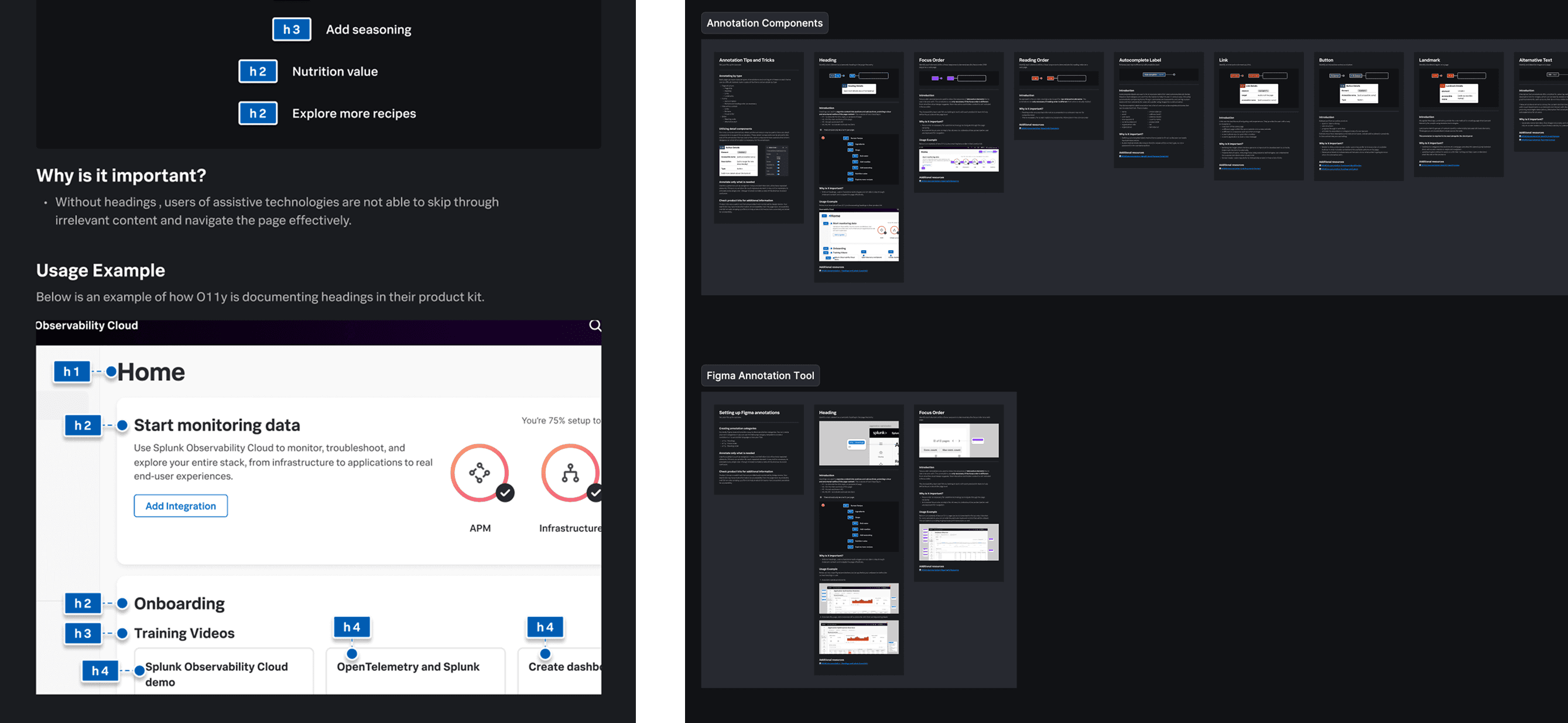
The new annotation kit guidance section featured guides with real product examples and usage guidance from the SUI team and accessibility ambassadors designated in adoption process.
A tool is only as effective as its adoption rate. To ensure the v1.0 kit didn't just sit in the library but became a foundational part of the Splunk design process, I architected a multi-channel rollout strategy focused on scalability, peer-to-peer leadership, and long-term education.
I leveraged high-visibility platforms to ensure the kit was top-of-mind for the entire organization. This included:
✻
Design All-Hands & Slack: Presenting the value proposition to the 100+ person design org to drive awareness.
✻
Design System + Accessibility Office Hours: Establishing a recurring feedback loop where I provided hands-on guidance for specific product use cases.
To make accessibility a Day 1 priority, I integrated the kit into the formal onboarding process. By creating a suite of asynchronous video guides, I ensured that every new 'Product Experience' (PX) designer is equipped to use the kit without requiring constant manual oversight from the Design Systems team.
Recognizing that I couldn't be in every product meeting, I established an A11y Ambassador program. I trained key designers across different work-streams to act as subject matter experts. These ambassadors now serve as 'first responders' for accessibility questions within their respective pods, decentralizing knowledge and scaling the impact of the v1.0 kit across the company
Moving forward, my focus is on measuring the delta in handoff efficiency. I am partnering with Product Kit Owners to provide ongoing guidance and ensure the kit evolves alongside our SUI 5.0 release cycle, maintaining its position as a live, essential resource for inclusive design.